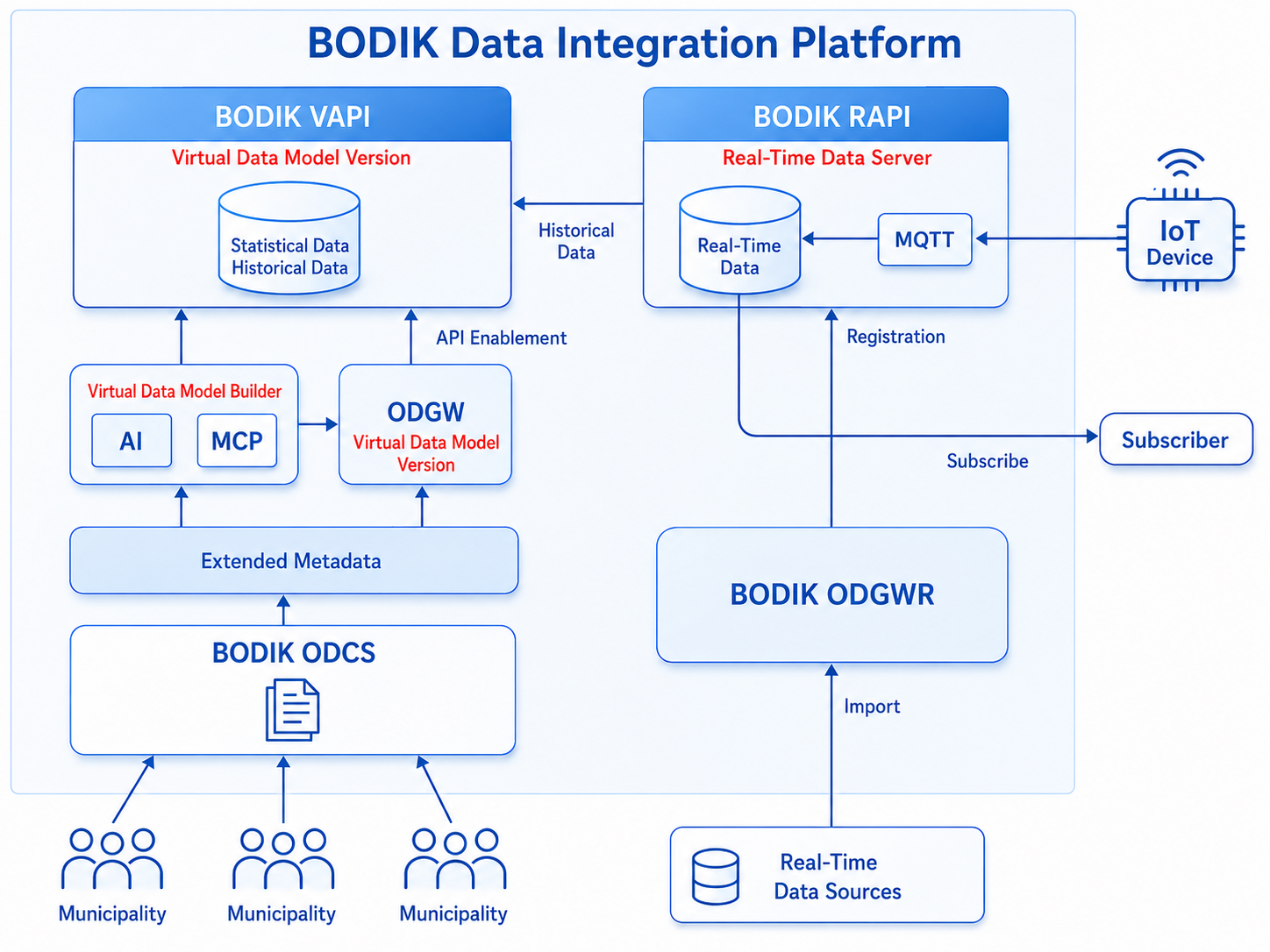
BODIK R&D does not treat the advancement of public data infrastructure as a single technical challenge. It defines distinct yet interconnected research domains addressing challenges that span multiple layers: data publication, collection, description, transformation, integration, delivery, and operation.
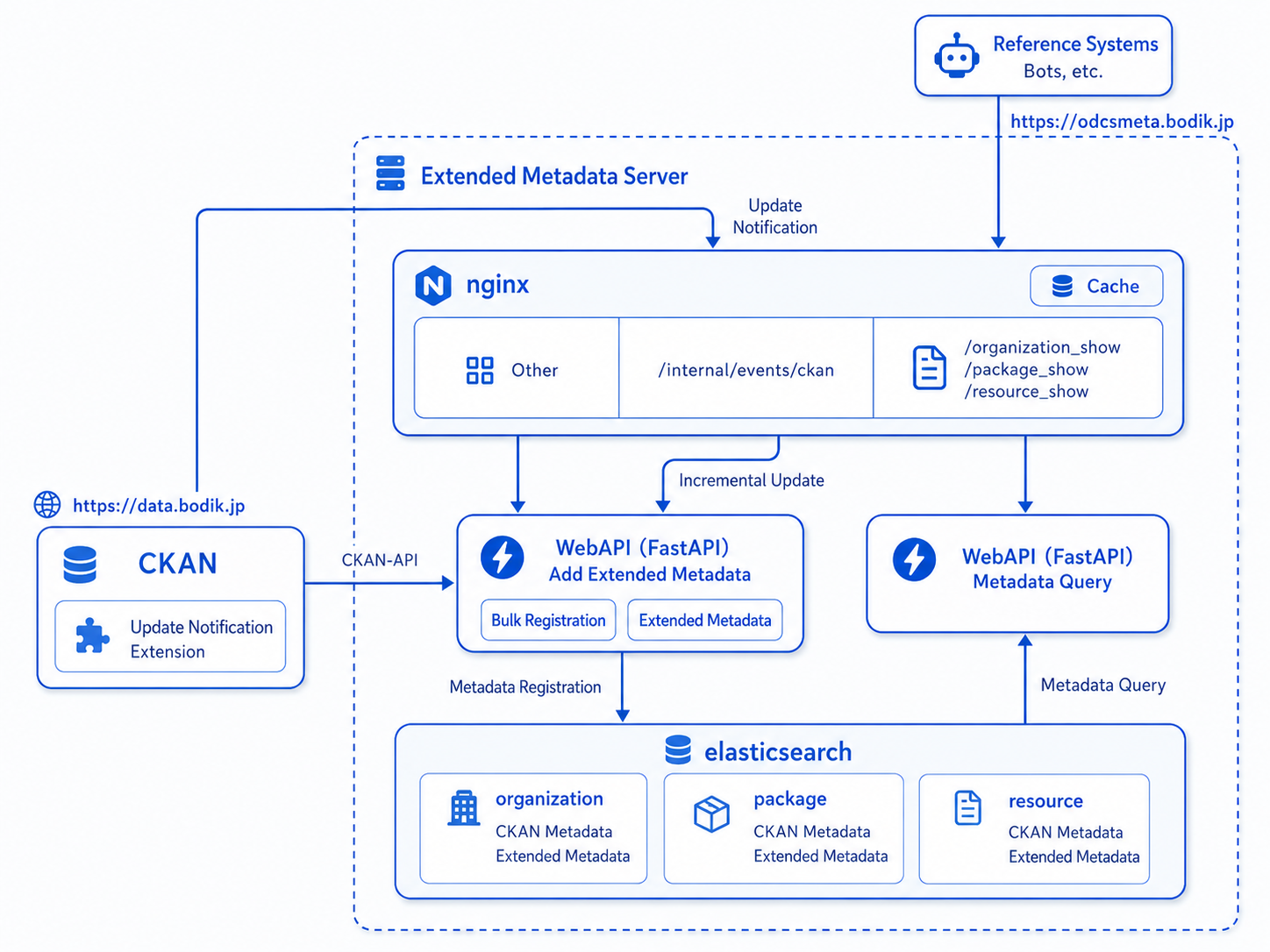
In the utilization of public data, metadata is just as important as the data itself. In practice, however, published metadata varies widely in descriptive granularity and expression across publishers — a disparity that becomes a major barrier when considering AI-based discovery, summarization, classification, and comparison.
BODIK R&D is pursuing research into multi-layered metadata enrichment. By building upon the original baseline information with a layer of machine-assisted supplementation and normalization, and then a further layer of AI-powered semantic enrichment and summarization, it aims to describe the content and intended use of datasets with much greater clarity.
The significance of this research lies not simply in producing richer descriptions. Making it easier for AI to grasp a dataset's subject, granularity, applicability, and related domains improves discoverability, recommendability, and comparability. BODIK R&D frames this state as AI Ready and positions it as a prerequisite for the next stage of public data infrastructure.
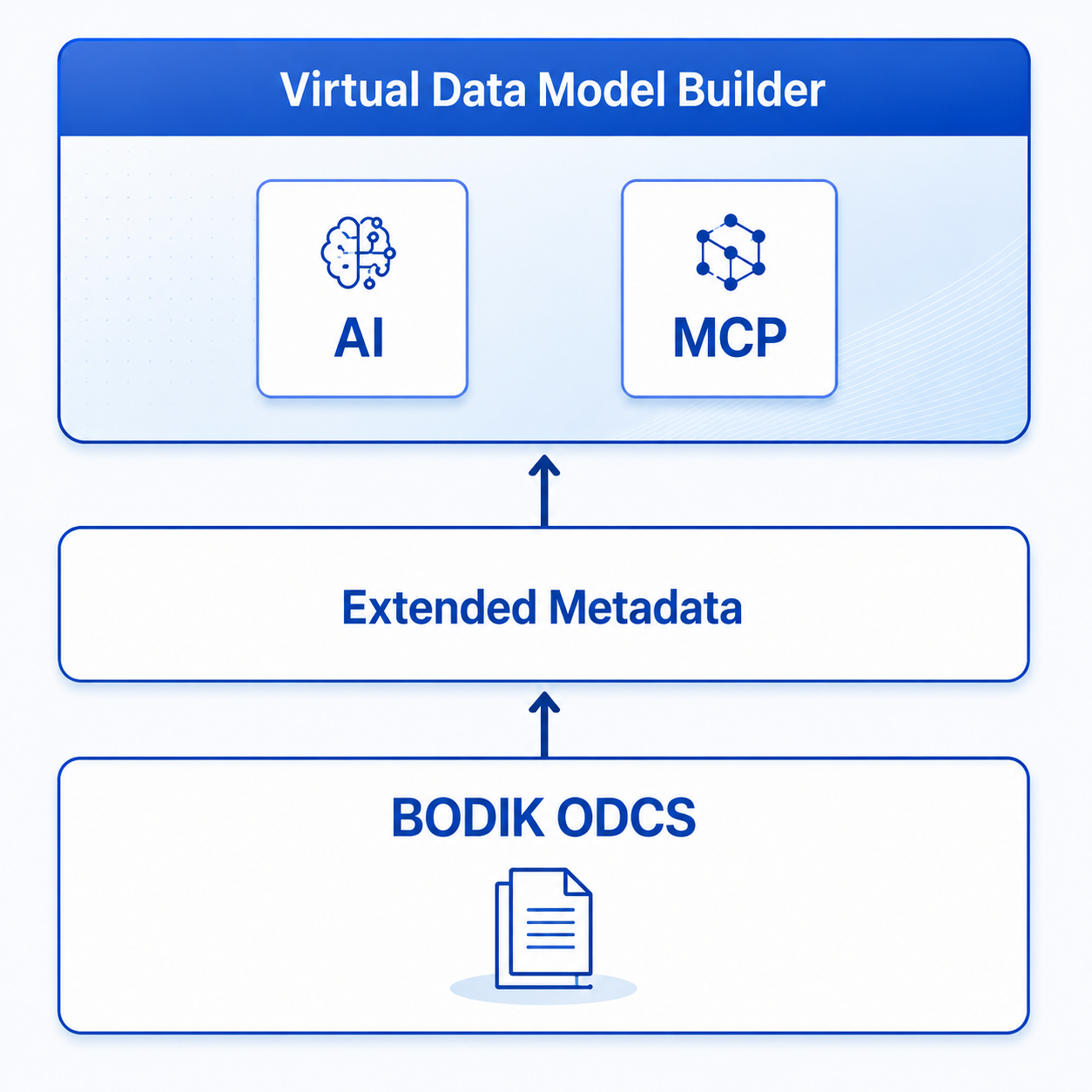
Even when public data addresses the same subject, column names, units, date notation, value representation, and granularity can vary significantly across municipalities. While these differences may be natural for each publisher, they present a significant barrier for users attempting cross-sectional comparison or integrated analysis.
To address this challenge, BODIK R&D adopts the concept of a virtual data model. Rather than forcing all data into a single unified format, this approach establishes an abstraction layer through which data can be referenced, retrieved, and compared in common terms while preserving the individual character of each dataset.
By using a virtual data model, operations such as field-name mapping, type conversion, date-format normalization, and unit correction become more readily absorbable at the API layer. Within BODIK R&D, the virtual data model is a core research domain for enabling cross-sectional data use.
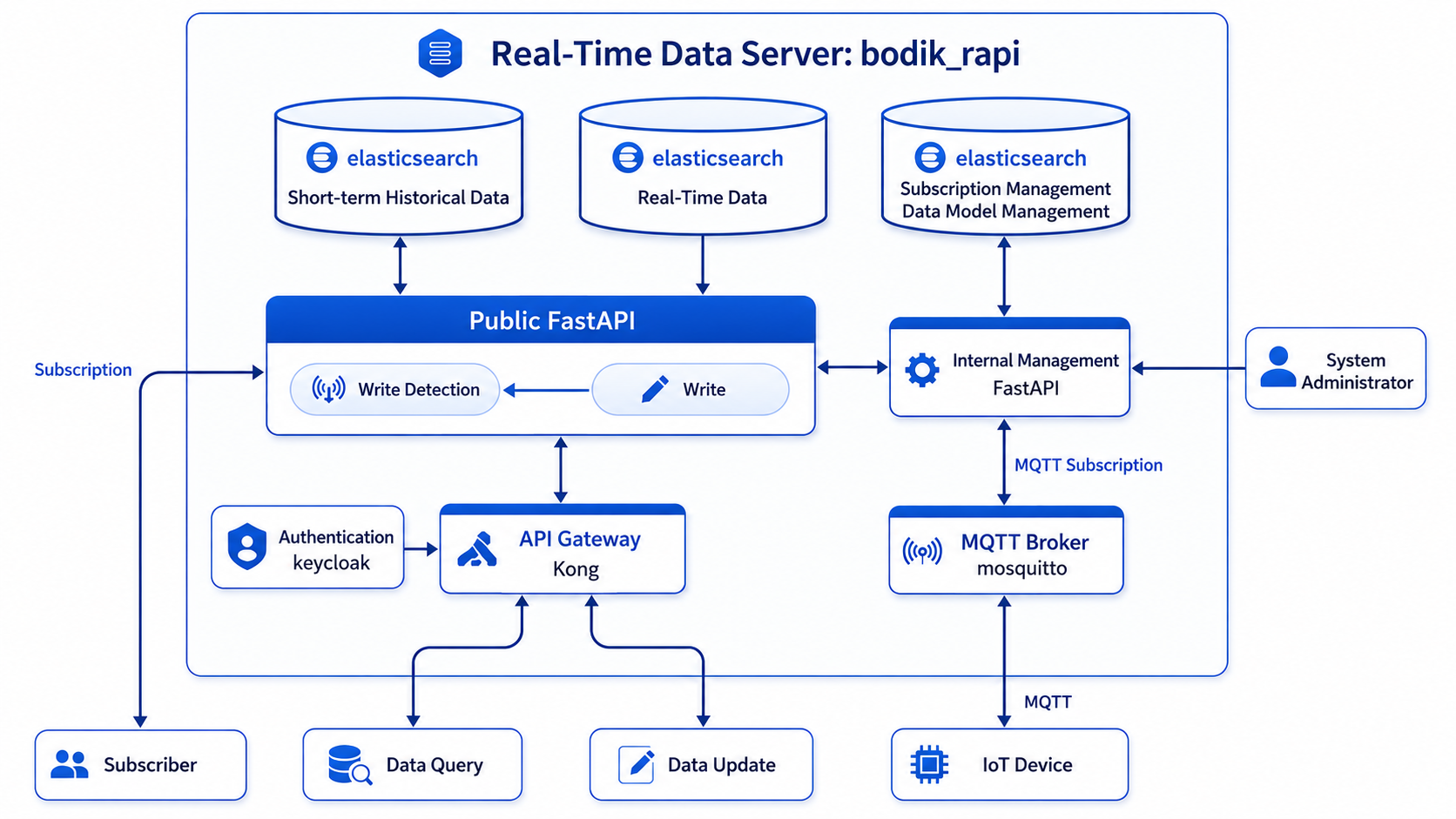
Most public data assumes a static file-based publication model. At the same time, the importance of data that changes over time — facility availability, disaster-response information, sensor readings, event data — is expected to grow. Handling such data requires an integration infrastructure distinct from simple catalog publication.
Rather than relying wholly on heavy-weight configurations, BODIK R&D researches lightweight real-time data integration using FastAPI, Elasticsearch, MQTT, and related technologies. The emphasis here is on comprehensibility, ease of deployment, and maintainability — not on comprehensive coverage of features.
By respecting interoperability with existing FIWARE-based assets and shared infrastructure, and by maintaining NGSI interfaces in new environments, the approach achieves gradual interoperability with existing infrastructure.
In operating public data infrastructure, far more manual effort goes into finding data, collecting it, preparing it, and reflecting it in the publication platform than into the data content itself. When these tasks depend on the individual efforts of responsible staff, both continuity and currency become unstable.
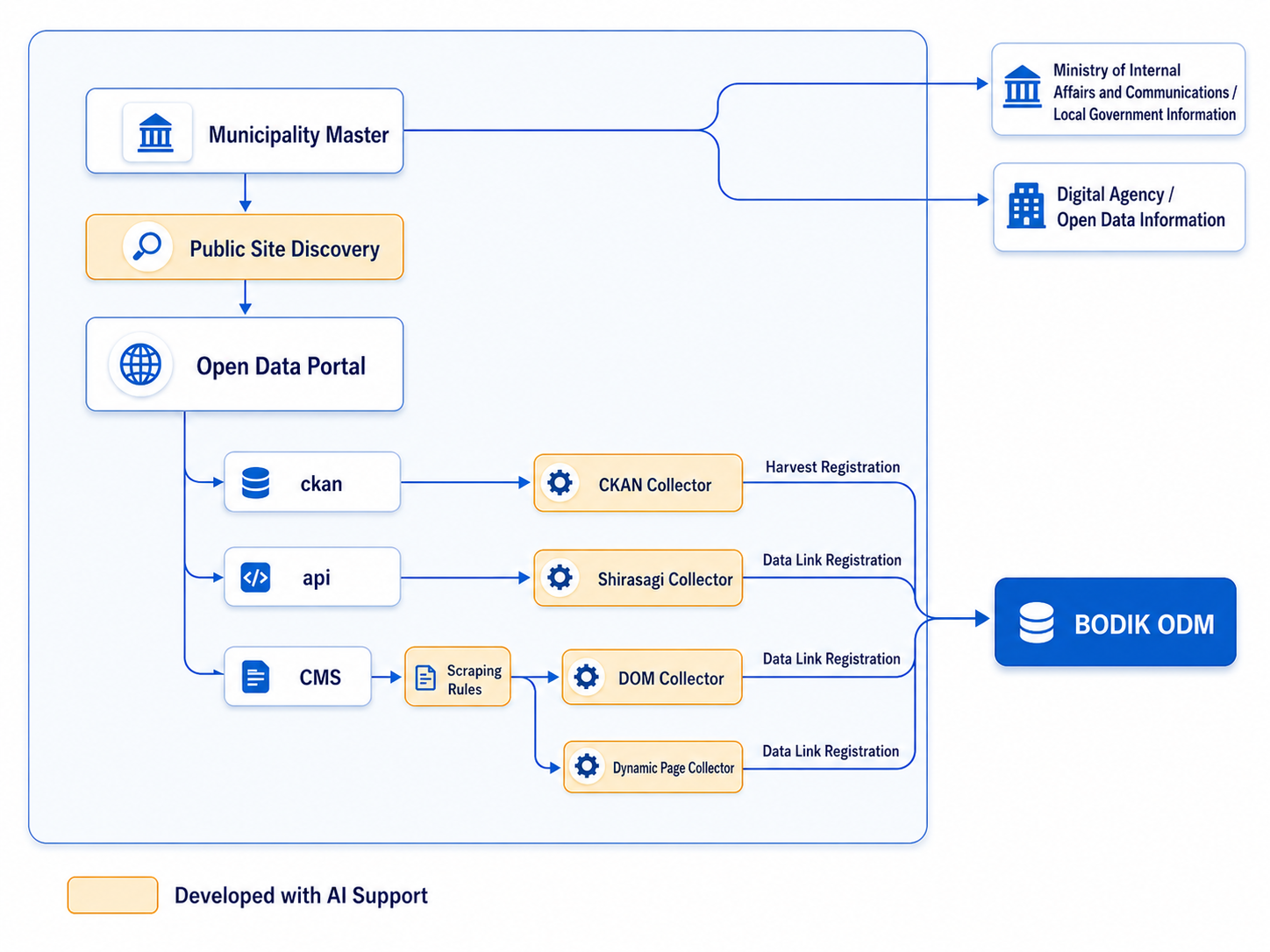
BODIK R&D is pursuing research to automate the stages of discovering published content on municipal websites, extracting it from existing CMSs, converting it to appropriate formats, and assisting with registration into publication platforms. This encompasses not only straightforward scraping but also intelligent processing: understanding target structures, detecting changes, handling unexpected modifications, and applying conversion rules.
Metadata enrichment, the virtual data model, real-time APIs, and automated discovery and conversion. If these exist only as separate entities, the value of the public data infrastructure as a whole cannot be fully realized. For users, the very fact that multiple technical components are fragmented can itself become a barrier to use.
Accordingly, BODIK R&D positions integrated platform design — encompassing authentication, API access, model management, data connectivity, and a user-facing interface — as a research domain. This domain is responsible not for leaving each technical result as a mere collection of parts, but for designing the system that makes them cohere as a single use environment.