
Architecture

Technical Architecture

The technical architecture of BODIK R&D is a lightweight yet extensible infrastructure configuration designed not merely to publish and store public data, but to simultaneously enable AI-based interpretation, cross-municipal reuse, real-time connectivity, and sustained operation in the public sector.
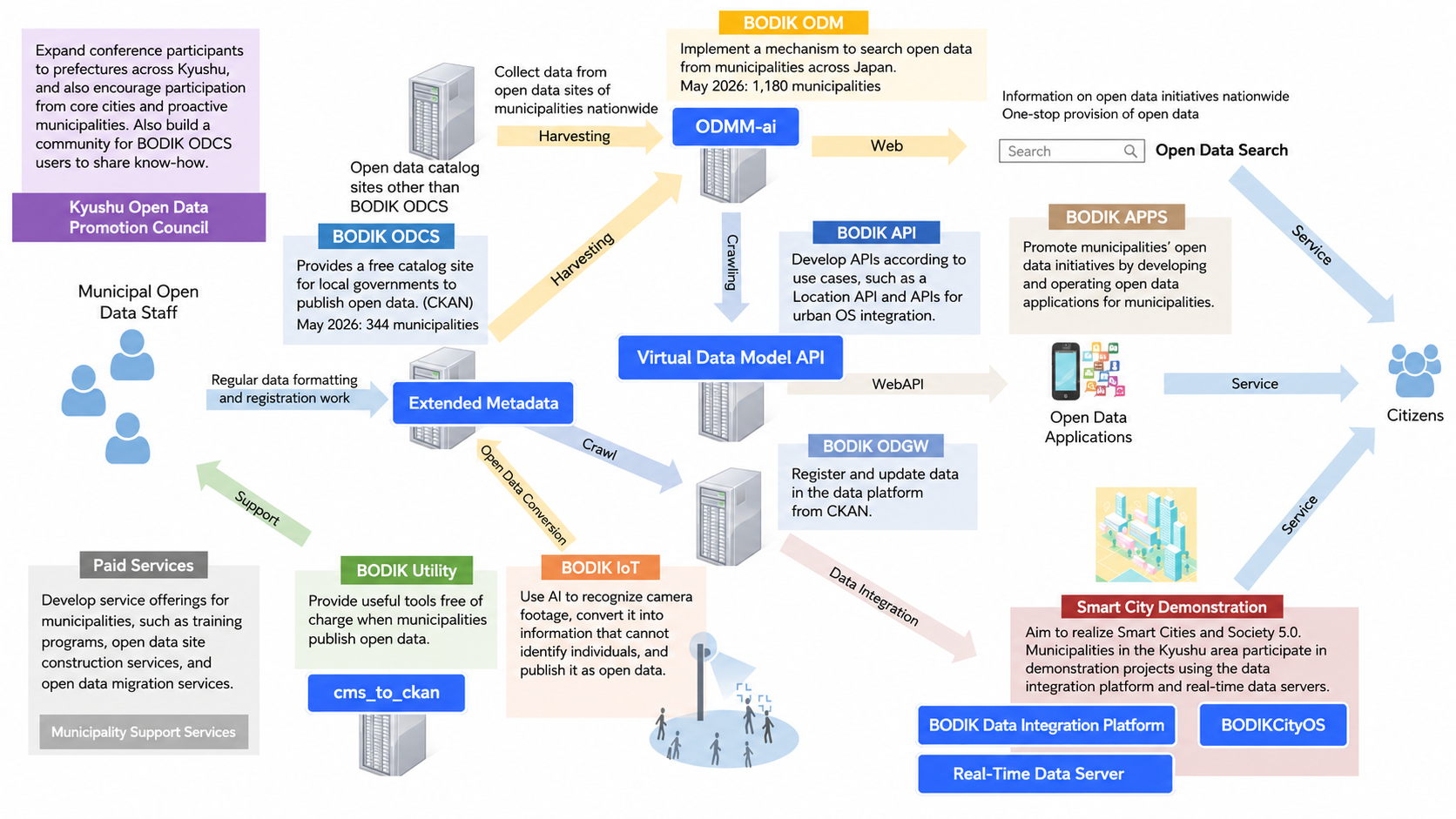
BODIK R&D six-layer architecture overview
An overview showing which layer each project occupies within the full architecture.
Design Principles

Design Philosophy

Design not to add complexity, but to enhance connectivity.

Comprehensibility
A configuration that remains legible through the full cycle of deployment, maintenance, and improvement
Deployability
Suited to the regulatory, staffing, and budgetary constraints of public-sector settings
Extensibility
Layer separation that allows starting small and expanding incrementally
Interoperability
NGSI interface ensures mutual operability with existing FIWARE-based assets
Layer Structure

Overall Architecture

A six-layer structure supporting publication, collection, semantic enrichment, cross-sectional use, and dynamic connectivity.

L6
Platform & Governance
Authentication, access control, API usage management, UI integration
Data Platform
L5
Access & API
NGSI I/F · cross-sectional API (VAPI) · real-time API (RAPI)
VAPIRAPINGSI I/F
L4
Modeling & Transformation
Virtual data model, type conversion, format normalization, cleansing
Virtual Model
L3
Metadata & Enrichment
AI-assisted metadata enrichment, semantic tagging, multi-layer description
Ext. Meta Server
L2
Collection / Ingestion
Discovery, retrieval, change detection, formatting, automated conversion
ODMM-aicms_to_ckan
L1
Source / Data Origin
Municipal CMSs, open data catalogs, sensors, external APIs
Municipal Data

Data Flow

Data Flow

Data is handled through the flow of being "discovered, prepared, understood, and used." Each layer relates not only as a sequential process but in a cyclical relationship.

01
Discovery & Collection
Locating and retrieving published content from municipal sites, CMSs, and catalogs
02
Formatting & Conversion
Normalizing formats, detecting changes, and reflecting them in the publication platform
03
Semantic Enrichment
Multi-layer metadata enrichment with AI assistance, toward AI-Ready description
04
Modeling
Assigning a common reference framework through the virtual data model
05
API Delivery
Unified NGSI-compliant interface via VAPI and RAPI
06
Integrated Use
A unified use environment with authentication, access control, and UI

Interoperability

NGSI / FIWARE Compatibility

BODIK R&D does not take an adversarial stance toward FIWARE.
In new environments as well, NGSI interfaces are maintained to enable interoperability with existing shared infrastructure and FIWARE-based assets.

In the public sector, fully replacing existing configurations with new ones — disregarding past demonstrations, existing deployed assets, and connectivity requirements with other infrastructure — is not realistic. By building NGSI interfaces into new environments, it becomes possible to extend the scope of connectivity incrementally while making use of existing assets.

BODIK R&D's position is not a binary choice between "FIWARE or non-FIWARE," but rather designing configurations that are more flexible and sustainable while remaining connected to existing infrastructure.
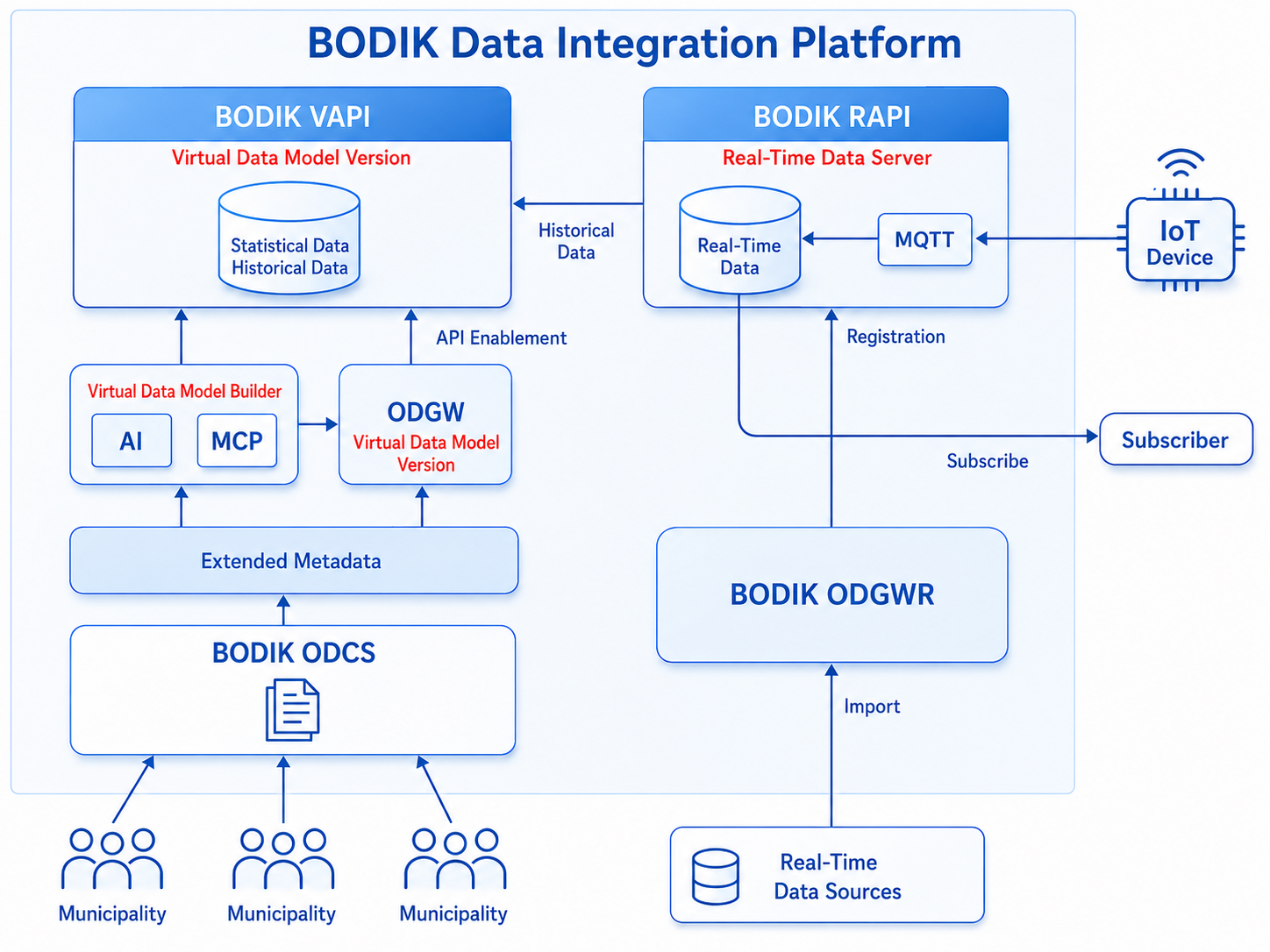
Tech Stack

Why We Choose a Lightweight Configuration

BODIK Data Integration Platform configuration concept
A concept image of the platform layer that bundles authentication, APIs, models, and user journeys.

What is needed in the public sector is infrastructure that is easy to deploy, easy to understand, easy to maintain, and capable of incremental expansion. Even a large and complex infrastructure that is theoretically feature-rich tends to create barriers to adoption and sustained operation in the field.

FastAPI
Lightweight, high-performance API foundation
Elasticsearch
Full-text search and metadata indexing
MQTT
Lightweight publish-subscribe notification protocol
NGSI v2 / LD
Interoperability interface with existing infrastructure
CKAN
Open data catalog integration
LLM API
AI-assisted metadata enrichment
This architecture is not designed to fix all use cases in place from the outset. It emphasizes positioning functions with high independence, clarifying integration points, and expanding the system incrementally.
View Projects View Roadmap